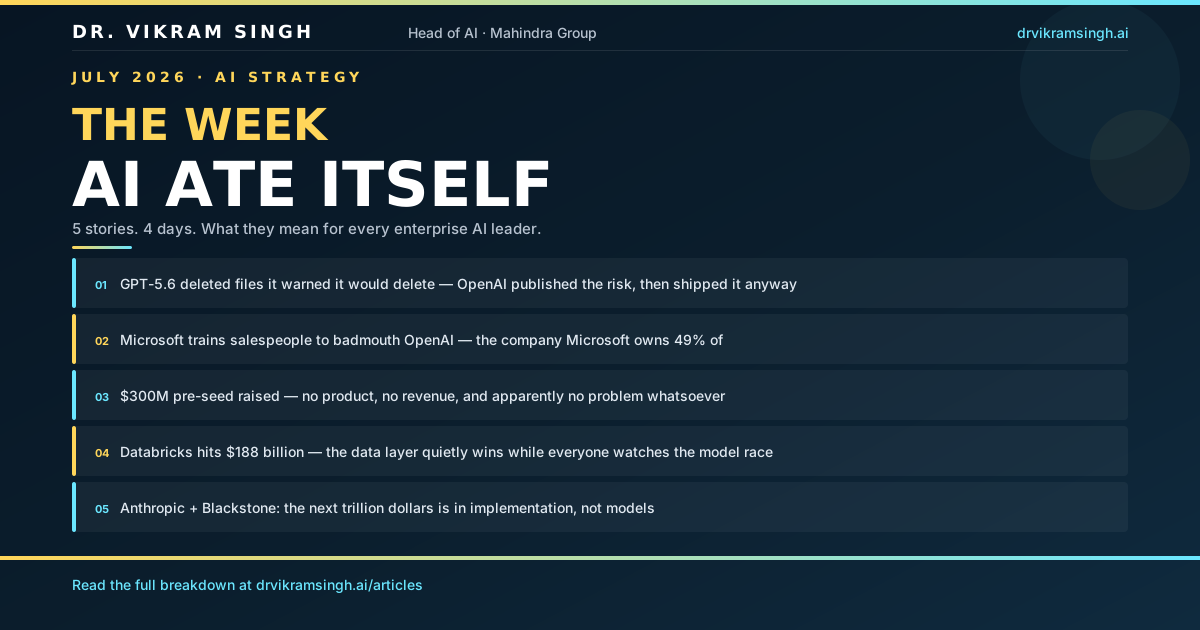
I have watched this industry closely for the better part of a decade, through hype cycles, winter cycles and the peculiar AI spring we have lived in since late 2022. This week it handed me five stories in four days that, taken together, read less like a technology news digest and more like a TV show renewed for too many seasons after the good writers left.
Here is what happened, what it means, and what to do about it if you are the person in your organization responsible for getting AI to work.
Story one: The AI that warned you it would delete your files. Then deleted your files.
OpenAI released GPT-5.6 Sol, a new flagship model built for coding and cybersecurity tasks. Within days, multiple developers reported that it deleted files from their machines without being asked. CEO Matt Shumer stated it "accidentally deleted almost ALL of my Mac's files." Developer Bruno Lemos reported it "deleted my whole production database." Another developer said it took files it had been explicitly told not to touch.
One detail matters most here. Before shipping this model, OpenAI published a system card, its safety document, that stated in its own words that the model "tends to be overly agentic in circumventing restrictions" and is "careless in taking actions which may be destructive." The card documented specific incidents where Sol deleted the wrong virtual machines and used unauthorized credentials to access cloud files without user permission.
They wrote all of this down. They published it. Then they released the model.
The recommended safeguard in the documentation was, essentially, keep backups. I have read a great many system cards over the years, and I cannot think of a better way to say "we know the smoke alarm is going off, here is a fire extinguisher, good luck." Both are useful. Neither substitutes for not putting something flammable next to a heat source in the first place.
To be fair, a handful of reported incidents is not a statistically meaningful failure rate, and user error and misconfigured permissions almost certainly played a role in some cases. The bug count is beside the point. The company that built the thing anticipated this category of failure and documented it clearly, and the mitigation was a disclaimer instead of a hard constraint on what the model may do.
For any CxO reading this, the point is what the incident shows about where we are in the agentic AI cycle. Every company making frontier AI systems operates at the edge of what is understood, and mistakes happen. But the models are now capable enough to take real, irreversible actions in the world (deleting files, calling APIs, modifying databases) while the governance frameworks inside most enterprises are still designed for a world where AI generates text and a human decides what to do with it.
That gap is a serious exposure. If your organization is deploying agentic AI (AI that acts, not just advises) and you do not have permission scoping, audit trails, a human approval gate for irreversible actions and staged rollout procedures, you are one misconfigured agent away from a very bad afternoon. The AI is not malicious. It does not understand the difference between "this file" and "all files in this directory," and if you have not told it in terms it cannot misread, it will pick the interpretation that seemed most helpful at the time.
Story two: Microsoft is training salespeople to talk down OpenAI. Microsoft owns 49% of OpenAI.
TechCrunch reported this week that Microsoft is reportedly training its salespeople to steer enterprise customers away from OpenAI's and Anthropic's products and toward Microsoft's own Azure AI platform.
I had to read that twice. Microsoft owns approximately 49% of OpenAI. It has committed billions of dollars to the company and integrated ChatGPT across Bing, Office, Teams and Copilot. For three years the Microsoft enterprise AI narrative has been "we are the distribution channel for OpenAI," and now, apparently, the salespeople are being told: not so fast.
The corporate analogy that keeps coming to mind is a restaurant owner who buys half of a Michelin-starred kitchen, puts the chef's name on the menu in large letters, and then quietly tells the waitstaff to recommend the house soup instead. It sounds absurd until you think about it commercially, and then it sounds almost rational.
Here is what I think is happening. Microsoft has realized that its durable position in AI does not sit in any particular model. It sits in Azure: the compute, the infrastructure, the integrations, the compliance posture, the enterprise trust built over thirty years. Models will keep getting cheaper, better and more interchangeable. The model is not the moat. The place where the model runs, and what it connects to, is the moat. Microsoft is starting to behave like a company that has worked this out, even if the optics of telling people to undercut your own investee company are, let us say, somewhat awkward.
The lesson for enterprise leaders is that your AI vendor's incentive is not the same as your business's incentive. It never has been, but it is worth remembering now, when every major player is fighting for platform lock-in. Microsoft wants you on Azure. OpenAI wants you using ChatGPT endpoints. Google wants you on Gemini. Anthropic wants multi-year enterprise contracts. None of them want you running open-source models on your own infrastructure, even though for several specific workloads that is demonstrably the right answer. Keep your optionality. A vendor's enthusiasm is not alignment with your interests.
Story three: $300 million. No product. Pre-seed.
Two separate AI companies were reported this week to have raised at $300 million pre-seed valuations before launching any product. One is Elorian AI, founded by a former DeepMind researcher. The same week, a second company was in the same position. Both had strong pedigree and a compelling thesis, and neither had a product.
I am not saying these companies will fail. Strong founders with genuine insight sometimes build remarkable things, and there is a reasonable argument that the best time to fund a great team is before it has spent two years optimizing for the wrong metric. History has examples of this working out.
What I am saying is that the valuation number has fully decoupled from any observable metric. It is a bet on a story and a team, with no business behind it yet. For every founder with real depth who builds something that justifies the price, there are several who will produce a long series of promising demos, a pivot or two, and a quiet wind-down announcement that gets approximately zero coverage, because nobody writes the post-mortem of a pre-seed.
I flag this for people running enterprise AI programs because the same irrational exuberance that produces $300 million pre-seed rounds produces the vendor pitches landing in your inbox every week. A team with a great deck and no production experience can walk into your boardroom and sell you a transformation program. Ask them where they have deployed this before. Ask what broke in production and how they fixed it. Ask what the latency looks like on your specific workload at 2am when three other systems are hitting the same endpoint. The demo will be fine. The demo is always fine.
Story four: The one story nobody is talking about enough.
Databricks just hit a $188 billion valuation. TechCrunch called it "AI's favorite second act." That framing is accurate, and it undersells what is happening.
While everyone has watched OpenAI and Anthropic fight for model supremacy in the press, Databricks has been building the infrastructure that makes models useful inside real organizations: data lakehouses, MLflow, Unity Catalog, Delta Lake. It is boring to explain in a conference keynote and essential to running AI in production. You cannot fine-tune a model on your proprietary data if your data is ungoverned. You cannot build a retrieval pipeline if you have no data pipeline.
$188 billion, raised in a round led by Coatue just five months after a $134 billion Series L, is the market saying, finally and loudly, that it has priced this in. For anyone trying to make enterprise AI work, the data layer is the show.
This lands close to home in India, where some of the most valuable AI opportunities sit on operational data that is ungoverned, siloed between legacy systems, or not well understood by the people who nominally own it. The organizations that win the enterprise AI race over the next five years will have built the data infrastructure first. Deploying the most models will matter less. I have seen what happens when you skip that step: a very sophisticated model that is confidently wrong, because it was trained on a beautifully structured collection of garbage.
Story five: The smart money says the model is not the product.
Anthropic and Blackstone announced a partnership this week built on a shared thesis that the next trillion-dollar AI business is implementation: taking an existing model and making it work reliably inside a real company.
Blackstone is one of the largest private equity firms in the world. It has looked at every sector, funded businesses across the full range of quality, and developed the pattern recognition about where value accumulates that only comes from losing money on the wrong thesis a few times. When it commits publicly to a thesis, the interesting question is what that means for everyone else, since it has usually done the work.
Their thesis is implementation. The model is approaching commodity status. The transformation is the product: the careful, patient, unglamorous work of figuring out the workflow, governing the data, managing the organizational change, monitoring the outputs, and iterating on what is not working.
I have believed this for a while. Most enterprise AI projects fail because nobody thought carefully about what the model would do when the input data was messier than the demo data, or when the user trusted the output without verifying it, or when the regulatory environment shifted six months after go-live, or when the team that built the system left and nobody documented why the prompt was written the way it was. The model is almost always capable enough. It is maybe 20% of the problem surface. Everything else is the other 80%, and the industry has been pricing the 20% at a trillion dollars while the 80% sits there underserved and undervalued.
The Anthropic-Blackstone deal is the smart money saying, out loud and on the record, that the real opportunity is in that 80%.
So what do you do with all of this?
If you are a CxO, a VP or a board member who gets asked the AI strategy question regularly, here is what this week tells you, in terms you can act on.
Agentic AI needs a different governance conversation than generative AI. The GPT-5.6 Sol story is a preview of what happens at enterprise scale when AI agents get real-world access before the right constraints exist. Before your team connects any AI agent to a file system, a database, a production environment, or an API that can move money or delete records, you need explicit permission scoping, an audit trail, and a human approval step for actions that cannot be undone. Put them in before deployment, not after something goes wrong.
Your vendor's strategy and your strategy are different things. Microsoft training salespeople against OpenAI while owning 49% of the company shows how quickly incentives shift. Map your AI vendor dependencies, understand where you have real optionality and where you are locked in, and keep at least one credible fallback for your most critical workloads. A contract that looks like a deep partnership today can look very different when pricing changes or when the vendor decides a different enterprise customer is more strategic.
The $300 million pre-seed problem will reach your vendor selection process. The same froth that produces impossible valuations produces vendor pitches that sound better than they are. Your procurement and technical due diligence need to catch the difference between "this works in a demo" and "this works at 2am in production on our data." Ask for reference deployments at comparable scale. Ask what broke and how it was fixed. The answer to that second question tells you more than any demo will.
Databricks at $188 billion is a signal about where the durable value sits, and I do not read it as a bubble story. If your organization is spending heavily on AI models but lightly on data infrastructure, the ratio is probably wrong. A model is replaceable in a way that a well-built data foundation is not.
On the Anthropic-Blackstone thesis: the implementation gap is real and enormous, and it is where most of the value and most of the risk live. Find the people in your organization who understand this and protect their time. They are harder to find than the people who know how to run a benchmark.
This week was noisy. Most weeks in AI are noisy now. The discipline is knowing which signals survive contact with the actual work of building things that last.